Think in Ranges, Not Hands
The single mental shift that separates recreational play from real study.
A beginner asks: what do I have? A studied player asks: what does my whole range look like here — and what does theirs?
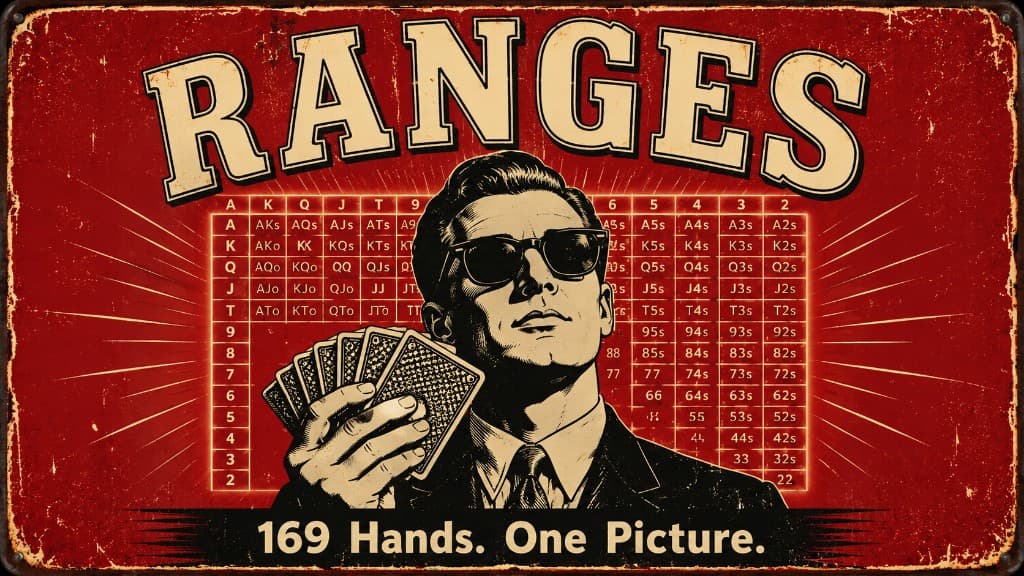
You never hold just one hand in a spot. You hold every hand you'd play the same way. The grid on the home page is the map: 169 starting hands, coloured by what a solver does with each. Reading a board through ranges instead of your two cards is the whole game in one habit.
This is why poker shares an epistemic backbone with every other bet worth making — you act on the distribution of outcomes, never on a single certainty.
Words that carry weight.
Range
The full set of hands a player can have in a given spot, weighted by how often each occurs.
Combo
One specific two-card holding. AKs is 4 combos; AKo is 12; a pair is 6.
Polarised
A range split into strong value and bluffs, with the middle checked or folded.
Range advantage
Whose range contains more strong hands on a given board — it dictates who can bet aggressively.
The board is A♠ K♦ 4♣. Who holds the range advantage: the preflop raiser or the caller?
Show the answer →Hide the answer ↑
The preflop raiser. Their range is dense with AK, AQ, AA, KK — the caller flatted these away preflop, so ace-king-high boards smash the raiser's range. They can bet small and often.
Stop asking 'is my hand good?' Ask 'how does my range interact with this board versus theirs?'