Pot Odds & Equity
The one calculation that makes every call correct or a leak.
A call is never about the hand — it's about a price. Pot odds compare what you risk to what you can win, and give you the exact equity you need to break even.
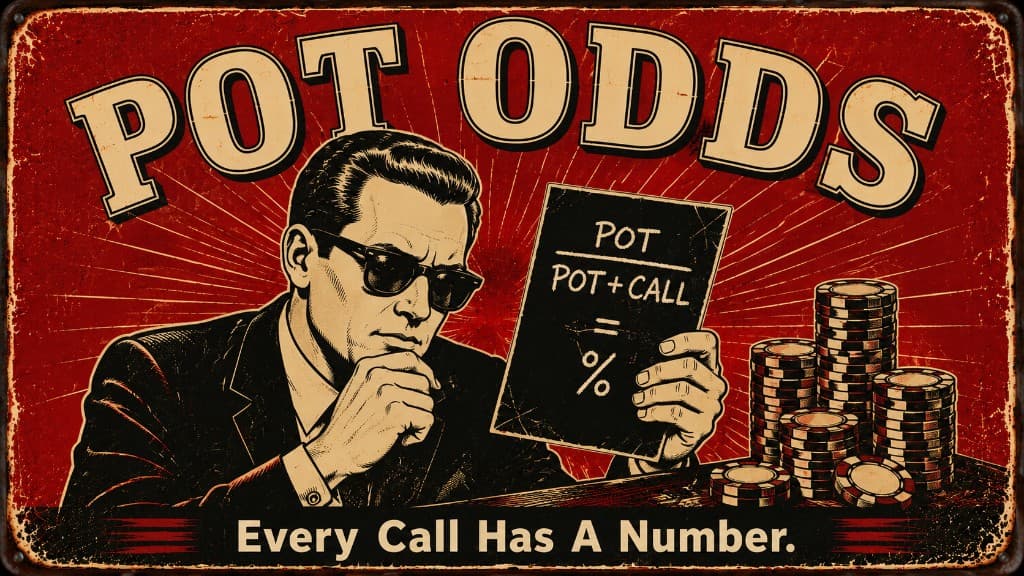
The formula is quiet and ruthless: to call a bet, you need equity ≥ risk ÷ (risk + total pot after your call). Face a half-pot bet and you need 25% equity. Face a pot-sized bet and you need 33%.
Count your outs, convert to equity with the rule of 2 and 4, and compare. Do this enough and 'do I feel like calling?' is replaced by a number.
Words that carry weight.
Pot odds
The ratio of the bet you must call to the total pot you'd win. Sets your minimum equity to continue.
Outs
The unseen cards that improve you to the likely best hand.
Rule of 2 and 4
×2 your outs on one street to come, ×4 with two streets, for a fast equity estimate.
Implied odds
The extra chips you expect to win on later streets when you hit — they justify some -EV immediate calls.
Pot is 100. Opponent bets 50. You have a flush draw (9 outs) on the turn. Call or fold?
Show the answer →Hide the answer ↑
Call. You risk 50 to win 150, needing 50 ÷ 200 = 25% equity. Nine outs on one card ≈ 9 × 2 = 18% — short on raw equity, but implied odds (the chips you win when the flush completes) push it profitable at most stack depths.
Before every call, name the price. Equity needed = risk ÷ (risk + pot). The number decides, not the gut.